

Chris Dunn is a seasoned journalist and copywriter with decades of experience under his belt. As the father of this magazine’s editor, he had to be our first official Perranporth Life contributor.
It was a dark and stormy night, December 27th in the year 1900, on record as the worst sea conditions in 20 years on Cornwall’s North Coast. And out beyond the raging surf, a French-flagged sailing ship was floundering helplessly in the boiling sea.
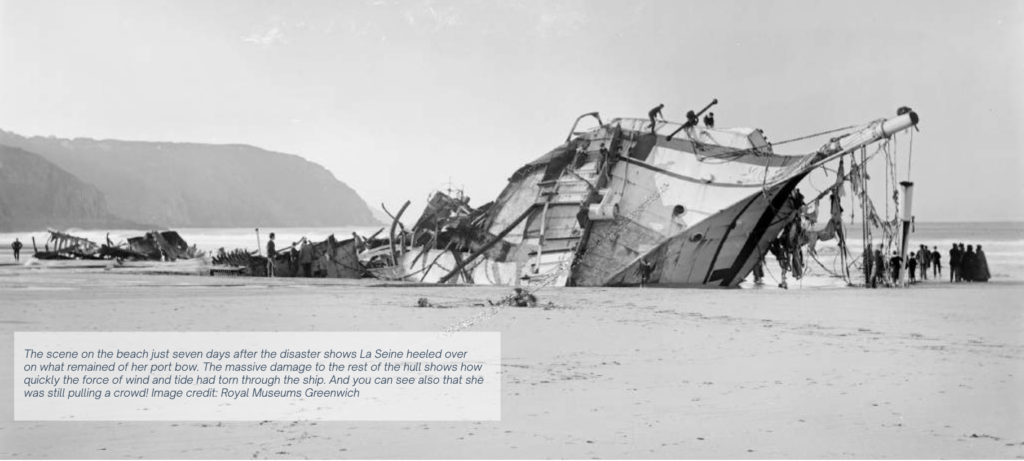
She was the 2000-ton sail-powered barque, La Seine, in desperate straits as the north-westerly gale drove her mercilessly ever closer towards the land. And when the inevitable final blow was struck, it was on Perranporth beach that she foundered, close by Droskyn Head and Chapel Rock.
I saw a TV programme about the menopause and they were covering all these fantastic things about what we can do as women to make ourselves fitter, healthier, At daybreak word spread rapidly as villagers hurried to the scene. Thanks to local folk, all 24 French crewmen, plus the cabin boy and the skipper, were brought safely ashore. Some were hauled from ship to dry land by a rope-and-line device fired by rocket onto the stricken vessel, while the less fortunate had to jump for their lives over the bulwarks and hope for rescue in the heavy surf.
As for the good ship La Seine, she was so badly damaged by the storm that there was no question of refloating her. So the wreck, sold a few weeks later for just £46, was stripped of all that might be useful or valuable, then left to the attention of weather and tide.
Though the remains of the ship have steadily broken up over the past 126 years, what now remains of her steel hull plates and frames can still be seen right there where she foundered—but visible only rarely, during particularly low-ebbing spring tides, when the exposed sand is washed back from around the skeletal remains.
From Chile to Cornwall
The three-masted steel barque, known as a ‘windjammer’, was safely 81 days out from the Pacific Ocean port of Iquique in Chile, bound for Falmouth and carrying a full cargo of potassium nitrate, a key component in the manufacture of fertiliser and gunpowder. The Panama Canal had not yet been cut, so the only practical route the ship could take was round the dreaded Cape Horn on the southern toe of South America, then north-eastwards across the Atlantic, driven by the trade winds.
But history tells us more about La Seine. We know that she had been built and launched very recently in Rouen, France; that she was apparently manned by a competent crew, commanded by an experienced skipper; and that those aboard were well accustomed to pretty much anything sea and weather could throw at them. And we may assume also that, in order for the ship to be driven onto a north-facing shore that fateful night, the wind can only have been coming from a northerly quarter.
And that brings us to one abiding question that remains unanswered, so far as I have been able to deduce.
What on earth was this vessel doing off the north coast of Cornwall?
After three and a half months of obviously competent navigation, she should already have found safety at anchor in Falmouth harbour, in the lee of the land on the south coast—only 15 miles distant across the Cornish peninsula, as the crow flies.
I wonder if the wreck of La Seine might tell us more when next she emerges from her grave beneath the sands of Perranporth.
Or perhaps you can suggest the answer to this mystery?